
Outside: the weather and air the device checks against
Sixteen tiles on the Outside screen: temperature and feels-like, wind and gusts, humidity, pressure, UV, rain, air quality index and dust. All of it feeds the advice to open a window.

Which numbers are normal
The zones on the device screen. Colour appears only where attention is needed.
| air index up to 50 | airing is fine |
|---|---|
| 51–100 | moderate |
| 101 and above | keep the window shut |
| UV index 3 and above | sun protection needed |
US EPA AirNow (AQI); WHO AQG 2021 — PM2.5 15 µg/m³ per day; WHO/WMO on the UV index
How it looks on the device
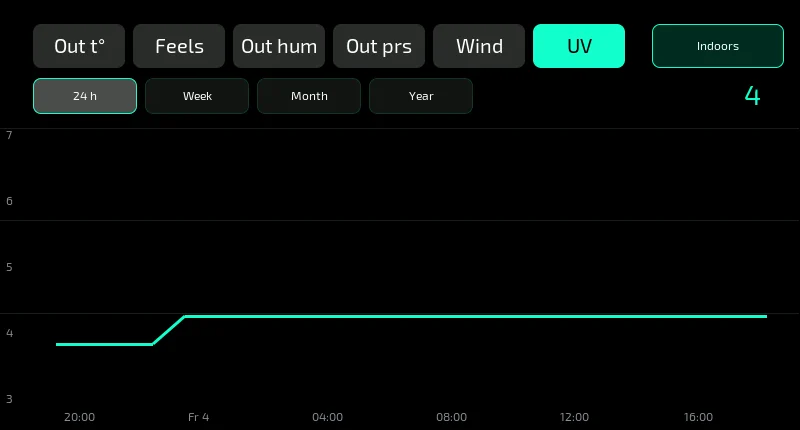
Real frames from the device, captured on 4 September 2026.


Why it matters
The advice to open a window without outdoor data can do harm: in smog the outside air is worse than indoors. So the device looks outside first.
PM2.5 dust — the finest particles that pass into the blood. There is no safe threshold; every +10 µg/m³ in large studies brings a noticeable rise in mortality.
The forecast comes from the open Open-Meteo service for your city, refreshes hourly and is stored on the device for a year. No keys, no accounts.
Feels-like temperature, gusts and dew point — to know how to dress a child, not just how many degrees it is.
WHO Global Air Quality Guidelines 2021; Di et al. NEJM 2017; US EPA AirNow
What the device says
Hints in words on the screen. Actions about the room, not about the body.
- “Take an umbrella” — when today's chance of rain is high.
- “Smog outside, keep the window shut” — with an air index above 100.
- “Tomorrow +16” — to decide in the evening what to wear in the morning.
Questions
- How does the device know my city?From the network's internet address at first start; the city can be refined in settings.
Other readings: Carbon dioxide · Temperature · Humidity · Pressure · Light · Noise