Knows what your room is breathing, and says when to open the window

A desktop device in solid ash: six readings of the room and the weather outside on one screen. No app, no cloud, no subscription.

See one day
FAVEO in a light ash body on a solid ash stand; the dark screen shows room readings and the weather
actual sizehalf actual size
  • Sensirion SCD40 infrared CO₂ sensor
  • 30 days of history on the device itself
  • Apple Home via Matter, no hub, no cloud
FAVEO on a wooden desk by a window, with books and a lamp

On the desk where you work and fall asleep: the screen reads from two metres away, and the ash does not argue with the wood of the table.

Why it matters

We spend almost our whole lives indoors, and what we breathe there can't be seen or felt until it is already bad.

A bright bedroom in the morning, bed by the window

Morning

Eight hours of sleep and still a heavy head. Usually it is not the coffee but the closed window: by morning a bedroom holds 2000–2500 ppm of carbon dioxide, six times the outdoor level. In a controlled study, people who slept at 850 ppm woke up sharper and more rested.

Strøm-Tejsen et al. Indoor Air, 2016
A desk by a large window looking over the city

Working day

In an office with the door shut the air turns heavy within an hour: CO₂ passes 1000 ppm and you crave coffee when what you need is a window. Work goes best at 21–22 °C and 300 lux on the desk; in the heat performance drops by almost a tenth.

Seppänen et al., LBNL; SanPiN 1.2.3685-21
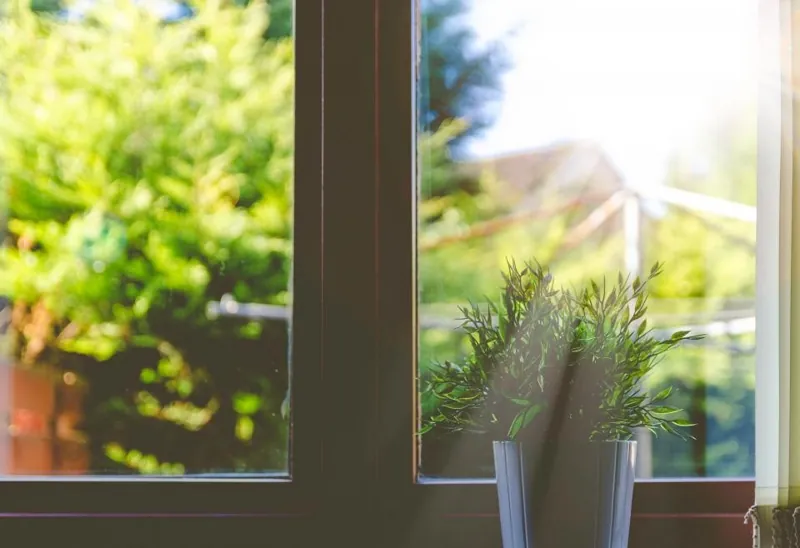
A windowsill with books, a cup and a plant

Winter

The heating comes on and the humidity in the flat drops to 15–20 %, desert level. Throats dry out, floors creak, and viruses stay airborne for hours. A humidifier is needed not “in winter in general” but when the screen shows less than 40.

Kudo et al. PNAS, 2019; Arundel et al. 1986

FAVEO makes these numbers visible: six sensors in the room, the weather and air outside, and one line on the screen — what to do right now.

One day from the device log

Wednesday, 2 September 2026. A reading every five minutes, the weather outside every hour. Nothing smoothed, nothing added.

400 600 800 1000 Indoor CO₂, ppm +14 +18 +22 +26 Temperature, °C: room — solid, outside — dashed 00:00 06:00 12:00 18:00 24:00 13:32 — 841 ppm, time to open a window 14:02 — window open, room −3 °C 18:02 — room empty, 454 ppm

Three entries from the same day. On the left what it measured, on the right what it said.

Room × outside

The advice “open a window” is only useful together with what is outside. So the device looks outside first.

Plants by an open window on a sunny day
Raindrops on a window pane

None of the 30 devices we checked turns “room × outside” into ready advice: the others show two numbers side by side and leave the conclusion to you.

Six readings of the room

Each reading in its own room: a bedroom at night, a sunny windowsill, a bookshelf. On the screen is a real 24-hour graph. Tap to open the page of the reading.

  1. Carbon dioxide, ppm

    Carbon dioxide, ppm

    The main sign of a stuffy room. Outside air is about 420 ppm, a fresh room stays under 800, above 1400 it is time to open a window. 4 September: night at outdoor level, people in the room from nine in the morning.

    under 800 — fresh · 800–1400 — getting stuffy · above 1400 — open a window

    In a controlled trial people slept worse at 2400–2600 ppm and were sleepier by day than at 850. CO₂ itself is not a poison: it is the most honest sign that a room has not been aired for a long time.

    Strøm-Tejsen et al. Indoor Air 2016; GOST 30494-2011; EN 16798-1
  2. Room temperature, °C

    Room temperature, °C

    The air, not the circuit board: the device subtracts its own heat. Living-room comfort by the Russian standard GOST 30494 is 20–25 °C, cooler for sleep.

    20–25 °C — comfortable · 18–20 and 25–28 — attention

    Above 24–25 °C sleep fragments: less deep and REM sleep. Below 18 °C in winter blood pressure rises. Peak work performance is around 21–22 °C; at 30 °C it drops by almost a tenth.

    WHO 2018; Okamoto-Mizuno & Mizuno 2012; Seppänen, LBNL
  3. Relative humidity, %

    Relative humidity, %

    In winter with the heating on it drops to 20–30 %: dry throat, cracking floors. Above 60 % in summer — mould and dust mites. The device tells you whether a humidifier is needed today.

    40–60 % — comfortable · 30–40 and 60–65 — attention

    At 40–60 % viruses, mould and dust mites are all at their lowest. Below 50 % dust mites die within 4–11 days. Above 60 % mould grows in corners and on windows.

    Arundel et al. 1986; WHO Dampness and mould 2009; Kudo et al. PNAS 2019
  4. Barometric pressure, hPa

    Barometric pressure, hPa

    Shown for reference with a three-hour trend. There is no health norm for pressure, so there are no coloured zones here.

    a change of 3–4 hPa in 3 hours is noted in words

    The link between pressure and how people feel was studied in 1.5 million patients and not found: no link with joint pain, a weak and unreproducible one with migraine. So the device shows pressure and its trend, but no coloured verdicts.

    Jena et al. BMJ 2017; Okuma et al. 2015
  5. Estimated noise level, dB(A)

    Estimated noise level, dB(A)

    The microphone measures level only, no audio is recorded. A quiet bedroom at night is under 30 dB, a conversation about 55. Not a certified sound meter, but it sees quieter and louder honestly.

    day under 40 dB, night under 30 — quiet

    Every +10 dB of night-time noise slightly raises the risk of hypertension, heart attack and diabetes in large cohorts. You cannot get used to noise at night: the pulse jumps even in people who “stopped noticing” the road years ago.

    Münzel et al. Eur Heart J 2014; WHO Community Noise 1999; SanPiN 1.2.3685-21
  6. Illuminance, lux

    Illuminance, lux

    0 lux at night, a bright room by day is 150 and more. This sensor dims the screen in the evening and tells the device you have gone to bed.

    150 lux and up by day — enough for reading and work

    Ordinary room light in the evening, under 200 lux, delays melatonin onset in almost everyone and shortens its night by an hour and a half. Just 5 lux in the bedroom at night doubled the risk of depression in a large cohort. By day, though, there is usually too little light: 300–500 lux against 100,000 outside.

    Gooley et al. JCEM 2011; Obayashi et al. HEIJO-KYO; Brown et al. PLOS Biol 2022
FAVEO Outside screen: temperature, feels like, humidity, pressure, wind, gusts, direction, cloud cover, dew point, UV index, rain, air quality index, PM2.5, PM10, today and tomorrow

Outside the window

The “Outside” screen: sixteen tiles of weather and air. The device compares them with the room before suggesting anything.

Weather now
Temperature, feels like, humidity, pressure, wind and gusts, cloud cover, dew point.
Air outside
Air quality index and PM2.5 / PM10 dust. When it is smoggy outside the device will not suggest opening a window.
UV and rain
Today's UV index, chance of rain, today's and tomorrow's forecast.
Source
The open Open-Meteo forecast for your city, refreshed hourly and kept on the device for a year.

Why FAVEO

We compared 25 devices by actual specifications, not promises. No one combines a true CO₂ sensor, a large screen and Apple Home without a hub. Noise, light and pressure together — nobody either.

DeviceCO₂ScreenNoiseLightPressureWeather on screenApple Home, no hubNo account, no cloudHistory on device
FAVEONDIR800×480, 4.3″yesyesyesyesyesyes30 days
Aranet4 HomeNDIRe-ink, smallnonoyesnono (Bluetooth)yesweeks
Qingping Air Monitor 2NDIR4″ 720×720yesn/anon/anono (Mi Home)n/a
SwitchBot Meter Pro CO₂NDIRsegment LCDnononon/avia hub, no CO₂yesn/a
Airthings View PlusNDIRe-ink 2.9″nonoyesnononono
Eve Roomno (VOC)e-ink 200×200nonononoyesyesn/a
Netatmo WeatherNDIRnoyesnoyesnono (HomeKit)nono
Marketplace “CO₂ sensor”eCO₂, estimatedLCDnononononono

Market research, July 2026, from manufacturer sites and independent reviews; “n/a” — not confirmed in the research. FAVEO and SwitchBot use the same SCD40 sensor; the difference is the screen and the fact that SwitchBot passes CO₂ to Apple Home only through a hub. Estimated eCO₂ in cheap devices is off by hundreds of ppm: it is calculated from volatile compounds, not measured.

Dead clouds
In 2022 Awair switched off its first-generation devices — working sensors became useless. In May 2026 the Netatmo cloud went down and people could not see data from sensors in their own homes. FAVEO stores and shows everything itself.
A screen, not an app
People check the app for the first two weeks and the device screen for years. Airthings shows data only in the phone; the Aranet screen is the size of a matchbox.
Honest CO₂
Marketplaces are full of “CO₂ stations” for a few dollars where CO₂ is guessed, not measured. Reviewers agree: only an infrared sensor is worth buying.

A month on the device

30 days in detail, daily summaries for years, hourly weather for a year — all inside, no server.

A month of humidity: the 30 / 40 / 60 / 65 % bands are the comfort limits
A month of CO₂: every peak is a closed room with people in it
The same history on a phone via the QR code on the device, no app needed

All of it is stored on the device and shown on its own screen or on a phone via QR code.

FAVEO close up: ash body, dark screen with room readings and the weather

Main screen of firmware 2.4.2, captured from the device on 4 September 2026, shown on a render of the 3D body model.

What is on the screen

CO₂
A number, a scale and a word: “air is fresh”, “getting stuffy”, “open a window”. The threshold is 800 ppm by GOST 30494.
Temperature and humidity
The air, not the circuit board: the device subtracts its own heat.
Light and noise
Lux and estimated decibels. No audio is recorded: the microphone counts level only.
Weather
Now, feels like, today and tomorrow, UV and air quality — from the open forecast for your city.
Colour
Normally the screen is almost black and white. Yellow and red appear only where attention is needed.

Who it is for

A woman reading in bed among plants

In the evening the device dims to 15 % and keeps quiet. In the morning it shows how much noise and CO₂ there was overnight.

The screen at night, and settings

Day and night brightness are set here; in between, the screen follows the light sensor
Date and time: synced from the internet, your own time zone
Settings: network, display, date, language, update

No cloud, no subscription

No cloud
The device measures, shows and stores history by itself. No account, no subscription; the internet is used only for weather and updates.
Apple Home
Via Matter over Wi-Fi. The Home app shows CO₂, temperature, humidity and the air quality index. No hub needed, an iPhone is enough.
Sound
The microphone computes a noise level in decibels. Nothing is recorded — there is nowhere on the device to store it.
Updates
Once a day the device checks for a new version and installs it over Wi-Fi. No cable, no computer.
Device history on a phone via QR code: a month of CO₂
History opens on a phone via the QR code on the device screen. No app, no account.

Specifications

Body129.5 × 91.2 × 33.4 mm, solid European ash, R2.5 corners
Stand108 × 63 × 52 mm, cut from one block of ash, 10° tilt
ScreenIPS 800 × 480 touch, active area 97.6 × 55.9 mm (4.3″), dark theme
CO₂Sensirion SCD40, infrared (NDIR), 400–2000 ppm, ±(50 ppm + 5 %)
Temperature, humidity, pressureBosch BME280; humidity ±3 %; ambient temperature corrected for self-heating
IlluminanceBH1750, 1–65,535 lux
NoiseMEMS microphone, estimated dB(A), 1-minute average; audio recording impossible
WeatherOpen-Meteo by location: now, feels like, today, tomorrow, wind, UV, air quality, PM2.5, PM10
History30 days at 5-minute steps; daily min, mean and max for 5 years; hourly weather for a year
Smart homeMatter over Wi-Fi; Apple Home sees CO₂, temperature, humidity and air quality index; no hub
NetworkWi-Fi 2.4 GHz; works without internet, account or vendor cloud
PowerUSB-C, 5 V
UpdatesOver Wi-Fi, checked by the device itself; current firmware 2.4.2
LanguagesRussian, English

Questions

Sources

  1. Strøm-Tejsen P., Zukowska D., Wargocki P., Wyon D.P. The effects of bedroom air quality on sleep and next-day performance. Indoor Air, 2016. doi:10.1111/ina.12254
  2. WHO Housing and Health Guidelines. Geneva: World Health Organization, 2018
  3. WHO Environmental Noise Guidelines for the European Region, 2018; WHO Guidelines for Community Noise, 1999
  4. Münzel T. et al. Cardiovascular effects of environmental noise exposure. European Heart Journal, 2014
  5. Arundel A.V. et al. Indirect health effects of relative humidity in indoor environments. Environ Health Perspect, 1986
  6. Kudo E. et al. Low ambient humidity impairs barrier function and innate resistance against influenza infection. PNAS, 2019
  7. WHO Guidelines for indoor air quality: dampness and mould, 2009
  8. Gooley J.J. et al. Exposure to room light before bedtime suppresses melatonin onset. J Clin Endocrinol Metab, 2011
  9. Brown T.M. et al. Recommendations for daytime, evening, and nighttime indoor light exposure. PLOS Biology, 2022
  10. Jena A.B. et al. Association between rainfall and diagnoses of joint or back pain. BMJ, 2017
  11. Seppänen O., Fisk W.J., Lei Q.H. Effect of temperature on task performance in office environment. LBNL, 2006
  12. WHO Global Air Quality Guidelines, 2021; US EPA AirNow AQI
  13. GOST 30494-2011; SanPiN 1.2.3685-21; EN 16798-1:2019
  14. FAVEO market research, July 2026: 25 devices from manufacturer sites and reviews by BreatheSafeAir, HouseFresh, Wirecutter, 9to5Mac

Interior photographs — StockSnap, CC0 (by Burst, Mary Whitney, Family First, Matt Hoffman, Joshua Ness, Olu Eletu, AJ Montpetit, Jake Ingle, Lia Leslie, Direct Media, Candace McDaniel). Screen captures and renders — the FAVEO device.